Ideas & Research

A platform built on
one central question

The Capacity Institute develops research, frameworks, diagnostics, and analytical systems focused on why institutions fail to execute — and how execution systems can be strengthened. Our work spans governments, corporations, development systems, infrastructure, and complex organisations globally.

Execution Systems State Capacity Institutional Coordination Delivery Systems Implementation Failure Organisational Execution Operational Governance Institutional Learning
NCIx 2026 — 54.2/100 The Capacity State Research Programmes

Why do institutions fail to execute — and how can execution systems be strengthened?

Intellectual Architecture

Core Concepts

The Institute has developed a distinctive set of analytical concepts for understanding institutional execution failure and the systems required to overcome it.

Concept 01

The Execution Gap

The distance between institutional intention and realised outcomes.

Many institutions possess strong ambition, strategic plans, policy frameworks, and financial resources — yet outcomes frequently underperform. The Execution Gap emerges when institutions are unable to translate intent into coordinated and sustained delivery.

Key Drivers

Coordination breakdown
Fragmented institutional authority
Weak delivery systems
Poor feedback mechanisms
Execution drift over time
Concept 02

Capacity Traps

Self-reinforcing cycles of institutional underperformance.

In low-capacity systems, reforms fail repeatedly, institutional trust declines, implementation capability weakens, and fragmentation deepens. Over time, systems become trapped in recurring cycles of weak execution that reform alone cannot break.

Core Insight

Reform without execution capacity reinforces weakness
Trust erosion reduces political will for reform
Fragmentation deepens across cycles
Concept 03

Coordination Failure

When institutional actors fail to align effectively toward shared objectives.

Modern institutions are highly interdependent. No major policy or strategy can succeed through isolated action. When coordination weakens, duplication increases, delivery slows, accountability fragments, and execution deteriorates.

Strategic Insight

Coordination is a core infrastructure of execution
Many institutional failures are coordination failures
Concept 04

Delivery Systems

The operational structures through which institutions produce outcomes.

Execution depends not only on ideas or leadership, but on the systems that convert decisions into implementation. Delivery systems include operational processes, implementation architecture, monitoring systems, and execution workflows.

Components

Operational processes and workflows
Implementation architecture
Monitoring and feedback systems
Delivery coordination structures
Concept 05

Institutional Coherence

The degree of alignment across actors, incentives, systems, and objectives.

Institutions frequently fail because their components operate in fragmented ways. High-performing systems demonstrate alignment, clarity, coordination, and operational integration across all levels.

What High-Coherence Looks Like

Aligned actors and incentives
Clear operational priorities
Coordinated delivery functions
Integrated governance systems
Concept 06

Execution Discipline

The sustained operational focus required for reliable delivery.

Many institutions launch ambitious initiatives but fail to maintain implementation discipline over time. Execution discipline requires operational clarity, monitoring systems, accountability structures, and sustained leadership continuity.

Required Elements

Operational clarity and focus
Monitoring and accountability structures
Leadership continuity
Delivery-oriented culture
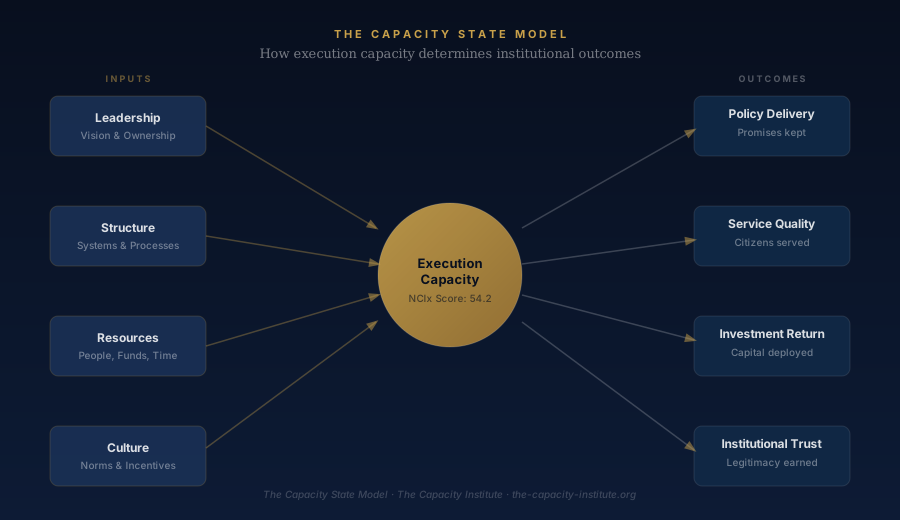
The Capacity State Model — showing how inputs (leadership, structure, resources, culture) feed into execution capacity, which produces outcomes
The Capacity State Model · The Capacity Institute — four input dimensions driving institutional execution capacity and its downstream outcomes.
Long-Term Research

Research Programmes

The Institute develops long-term research programmes focused on execution systems across institutional domains.

State Capacity Research Programme

Research Focus

Understanding how states develop the ability to execute policy consistently and at scale — examining the operational, institutional, and political determinants of effective state delivery.

Research Areas
Administrative capability
Coordination systems
Delivery architecture
Implementation failure
Federal execution systems
State capacity diagnostics
See the NCIx — Applied State Capacity Research

Organisational Execution Research Programme

Research Focus

Understanding why organisations fail to translate strategy into operational outcomes — examining the structural, cultural, and systemic causes of corporate execution failure.

Research Areas
Strategy execution dynamics
Organisational fragmentation
Coordination systems
Operational performance
Execution culture
Delivery system design
See the Corporate Execution Practice

Development Delivery Research Programme

Research Focus

Understanding implementation failure across development systems — analysing why well-funded, well-designed programmes consistently underperform in execution.

Research Areas
Aid delivery systems
Donor implementation structures
Programme execution failure
Institutional coordination
Development delivery monitoring
Operational reform
See the Development Delivery Practice

Infrastructure Delivery Research Programme

Research Focus

Understanding execution challenges in large-scale infrastructure systems — examining why major projects consistently face delays, cost overruns, and incomplete delivery.

Research Areas
Procurement systems
Project delivery systems
Execution bottlenecks
Coordination architecture
Delivery risk systems
Infrastructure diagnostics
See the Infrastructure Practice
Flagship & Strategic Publications

Publications

Future Publication Categories

Major Reports

Large-scale institutional diagnostics and analytical assessments. Including the annual Nigeria Capacity Index.

Strategic Briefs

Focused analyses for institutional leaders on specific execution challenges, policy implications, and reform options.

Working Papers

Advanced conceptual and analytical work developing the Institute's intellectual frameworks and research findings.

Execution Notes

Short operational insights on institutional execution — rapid analysis of emerging patterns and institutional dynamics.

A Distinct Framework

Execution Thinking

Execution capacity requires a distinct intellectual framework. The Capacity Institute is building a body of analytical work focused specifically on execution systems as a field of inquiry — separate from, but connected to, existing traditions in governance, public administration, and organisational theory.

Key Questions This Field Addresses

Why do institutions fail operationally despite strong intent?
What enables some systems to deliver reliably while others repeatedly fail?
How do coordination systems determine institutional outcomes?
Why do well-designed reforms consistently underperform?
How do high-capacity systems sustain delivery over time?

Long-Term Objective

To establish execution thinking as a recognised field of institutional analysis and operational practice

The long-term ambition of the Institute's research platform is not merely to contribute to existing discussions. It is to help establish execution capacity as a central domain of institutional analysis — connecting governance, systems theory, institutional analysis, organisational execution, and operational strategy into a coherent intellectual tradition.

Connecting disciplines

Governance Systems Theory Institutional Analysis Organisational Execution Operational Strategy Implementation Science

The intellectual foundation

"The quality of institutional outcomes depends not only on what institutions decide — but on whether they possess the systems required to execute effectively."

The Capacity State
Analysis & Commentary

Insights & Analysis

State Capacity Execution Failure Delivery Systems Coordination Governance

Insights & Analysis — Coming Soon

The Institute's analysis and commentary platform is being developed. Subscribe below to be notified when new pieces are published.

How We Research

Methodology

The Institute's research methodology is grounded in systematic institutional analysis rather than anecdote or advocacy. We draw on a combination of primary data collection, secondary analysis, stakeholder engagement, and structured case study methodology — always anchored to the five-dimension NCIx framework.

The NCIx framework measures execution capacity across five dimensions: Political Commitment, Coordination, Administrative Capability, Delivery Systems, and Feedback & Adaptation. All research outputs are mapped to these dimensions to ensure consistency and comparability.

Document Analysis

Review of institutional strategies, performance reports, policy documents, and budget data.

Stakeholder Interviews

Structured conversations with institutional leaders, practitioners, and subject-matter experts.

Comparative Analysis

Cross-country and cross-sector comparison using standardised NCIx scoring rubrics.

Literature Review

Systematic review of relevant academic, policy, and practitioner literature.

Field Observation

Where possible, direct engagement with institutions in their operational context.

Evidence Base

Data Sources

The Institute draws on a wide range of primary and secondary data to build its evidence base — complemented by original primary research conducted directly by the Institute's research team.

World Bank Governance Indicators
UN Development Programme datasets
IMF Fiscal Monitor & Article IV Reports
African Development Bank data
National budget and expenditure data
Government performance reports
Corporate regulatory filings
Civil society monitoring reports
Peer-reviewed academic literature
Institute primary interview data
Data Access Enquiries
Active Research

Current Projects

Research projects currently underway at The Capacity Institute.

State Capacity Active

NCIx Annual Measurement Programme

Annual

The ongoing programme to measure, track, and publish institutional execution capacity scores across African economies. The NCIx 2026 inaugural edition is published; NCIx 2027 methodology review begins Q3 2026.

Cross-sector Active

The Execution Gap Study

Multi-year

A structured study mapping the gap between stated institutional objectives and operational outcomes across a sample of public and corporate institutions. Preliminary findings underway.

Government In Development

Nigeria Institutional Performance Database

Annual

Development of a longitudinal database tracking key execution-relevant metrics across Nigerian federal ministries, departments, and agencies over time.

Government In Development

Coordination Architecture Study

2026–2027

An examination of how coordination systems are designed and how they perform across Nigerian federal government institutions — identifying structural patterns associated with better or worse delivery outcomes.

Corporate Forthcoming

Corporate Capacity Benchmark

2026

A benchmarking study of execution capacity in a sample of Nigeria's largest listed companies — measuring strategy-to-execution alignment, operational performance, and delivery system quality.

Development Forthcoming

Development Partner Delivery Review

2026

An analysis of delivery performance across major development programmes operating in Nigeria — examining how the execution quality of international and bilateral programmes compares to stated programme objectives.

Collaboration

Research Partners

The Capacity Institute actively seeks research partnerships with universities, think tanks, policy institutes, development organisations, and government research units that share an interest in institutional performance, execution capacity, and delivery systems.

Partnership arrangements can include joint research projects, shared data access, co-authored publications, policy engagement, and event collaboration.

What We Look For in Partners

Shared focus on institutional performance, execution, or delivery systems
Commitment to evidence-based, rigorous research
Access to relevant data, institutions, or policy communities
Interest in cross-sector or comparative research approaches
Willingness to engage practitioner and policy audiences
Propose a Partnership
Fellows Programme

Research Fellows

The Capacity Institute's Research Fellows Programme provides senior researchers, practitioners, and policy professionals with an institutional home for independent work on execution capacity — gaining access to the Institute's frameworks, networks, data, and publication platforms.

Senior Research Fellow

For established researchers with a track record of publication in relevant fields. Full access to Institute research infrastructure.

Practitioner Fellow

For experienced institutional practitioners seeking to document, analyse, and publish insights from their operational experience.

Policy Fellow

For policy professionals seeking to engage with the Institute's research frameworks in the context of specific policy challenges.

The Fellows Programme is currently accepting expressions of interest. Formal appointments will begin Q3 2026.

Express Interest in Fellowship
Coming Soon

The Capacity Observatory

The Capacity Observatory will be the Institute's live data and monitoring platform — providing continuously updated institutional capacity data, scorecard tracking, trend analysis, and country-level intelligence for policymakers, researchers, and institutional leaders.

The Observatory will host the Global Capacity Index, Africa Capacity Index, Corporate Capacity Index, and related measurement programmes — making execution capacity data accessible and actionable for a wide audience.

Notify Me at Launch Request Data Access
Global Capacity Index

Annual rankings of national execution capacity across all major economies.

Forthcoming
Africa Capacity Index

Detailed measurement of execution capacity across 54 African nations.

Forthcoming
Corporate Capacity Index

Execution capacity benchmarks for listed and major private companies.

Forthcoming
NCIx Live Tracker

Real-time monitoring of Nigeria's institutional execution capacity metrics.

Forthcoming
Get Involved

Research Opportunities

The Institute offers a range of pathways for researchers, practitioners, and institutions to engage with and contribute to its research programme.

Research Fellowship

Academics and senior practitioners seeking an institutional affiliation and publication platform for work on execution capacity.

Express Interest →

Research Collaboration

Universities, think tanks, and policy institutes seeking to partner on joint research projects, shared datasets, or co-authored publications.

Propose Collaboration →

Data Contribution

Institutions or research teams with access to relevant institutional performance data and willing to contribute to the Institute's evidence base.

Contact Research Team →

PhD Affiliation

Doctoral researchers working on execution capacity, state capacity, or related institutional topics seeking affiliation and mentorship.

Enquire →

Observer Status

Policy professionals and institutional leaders seeking to follow the Institute's research and participate in research events without formal affiliation.

Register Interest →

Sponsored Research

Governments, development partners, and corporates seeking to commission focused research on specific institutional execution questions.

Commission Research →
Long-Term Intellectual Ambition

The future of institutions will depend not only on the quality of their ideas — it will depend on whether they possess the systems required to execute them.

The Institute's long-term research ambition is to help establish execution capacity as one of the defining institutional priorities of the twenty-first century — building a field that bridges conceptual analysis and operational practice.