Flagship Publication · The Capacity Institute
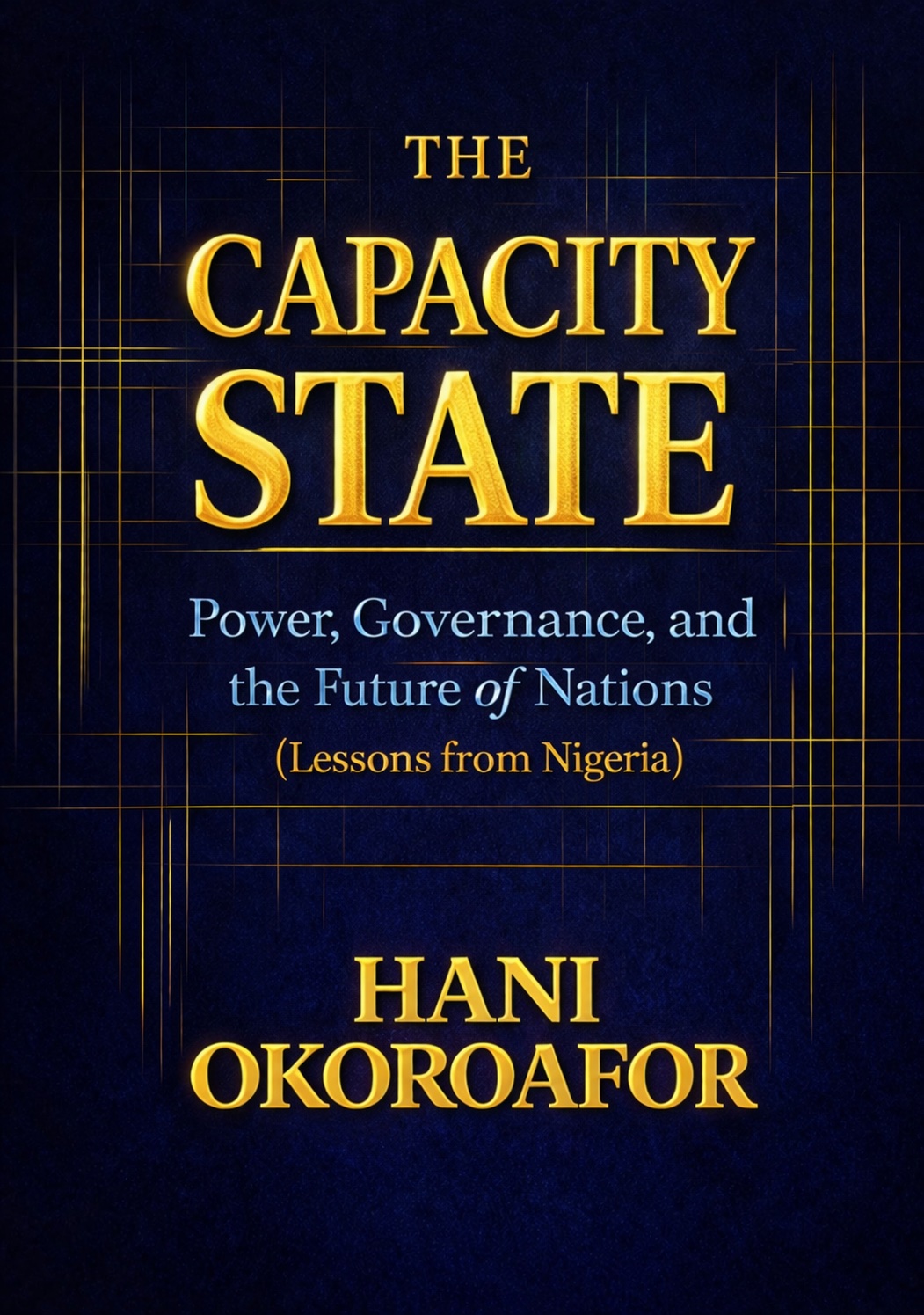
The

Capacity
State

Power, Governance, and the Future of Nations
(Lessons from Nigeria)

By Hani Okoroafor

A landmark examination of why states repeatedly fail to translate ambition into execution — and what it takes to build institutions capable of governing and delivering at scale. The foundational intellectual work of The Capacity Institute.
Expert Views on The Capacity State

This book provides a valuable bridge between the theory of state capacity and the realities of policy delivery.

Sir Tim Besley

Professor of Economics and Political Science, London School of Economics

A powerful and practical framing of why policies fail—and what it takes to make them work.

Dr Okey Enelamah

Former Minister of Industry, Trade and Investment

The Capacity State offers an articulate reframing of governance – shifting the focus from policy design to the systems required to deliver impactful results.

Ayo Gbeleyi

Director General, Bureau of Public Enterprises

Its emphasis on execution and system capability reflects realities that are widely experienced but rarely articulated with this level of clarity.

Richard Iferenta

Partner and Vice-Chair, KPMG LLP (UK)

A sharp and timely analysis of the gap between policy intent and real-world performance—grounded in the realities of building functioning systems.

Haruna Jalo-Waziri

Former CEO, Central Securities Clearing System Plc

An insightful and practical account of the persistent challenge of translating strategy into consistent outcomes across complex institutions.

Dr Imo Itsueli

Chairman, Nigerian National Petroleum Corporation (1992–1994)

A rigorous and original systems-level contribution, offering a compelling framework for understanding why well-resourced institutions underperform—and what it takes to convert policy ambition into sustained outcomes.

Admiral Kehinde Komolafe

Former Chief of Finance & Budget, Nigerian Navy

The Central Argument
Many states do not primarily suffer from a lack of ideas.
They suffer from a lack of execution systems.

Across governments globally, recurring patterns emerge: reforms fail repeatedly, implementation weakens, coordination fragments, delivery systems deteriorate, and institutional learning remains weak. This creates persistent gaps between policy ambition and operational reality.

The Capacity State argues that this gap — the distance between what institutions intend to achieve and what they actually deliver — is the defining governance challenge of our era.

The book draws on Nigeria as a primary lens, but its lessons reach far beyond: into every complex institutional environment where ambition consistently outpaces execution.

Core Concept

The Execution Gap

The distance between institutional intention and realised outcomes — and the systems required to close it permanently.

Coordination breakdown
Fragmented institutional authority
Weak delivery systems
Insufficient feedback mechanisms
Execution drift over time
The Capacity State Framework

Six Pillars of the Capacity State

State capacity emerges when six institutional pillars align within a coherent architecture. They are not independent — each reinforces the others. When they function together, institutions acquire the ability to translate national potential into sustained development.

01

Fiscal Sovereignty

Fiscal systems capable of sustaining long-term investment — mobilising, allocating, and deploying resources with discipline and predictability.

02

Administrative Competence

Professional bureaucracies able to implement policy effectively — with the skills, incentives, and institutional memory to deliver consistently at scale.

03

Coordinated Governance

Coordination mechanisms that align the actions of multiple institutions — resolving fragmentation, reducing transaction costs, and enabling coherent policy delivery.

04

Productive Federalism

Federal governance structures that balance autonomy with national coherence — enabling subnational delivery without fragmenting overall system performance.

05

State–Market Synergy

Productive relationships between the state and private enterprise — moving from rent-seeking equilibria to compounding arrangements that expand national capacity.

06

Human Capital Systems

Human capital systems that preserve institutional knowledge across generations — building the capability and continuity required for long-term state performance.

A Key Concept

The Capacity Trap

Capacity traps are self-reinforcing cycles of institutional underperformance. Reform without execution capability often reinforces weakness rather than solving it.

1
Reforms are launchedAmbitious policy and institutional change is announced with genuine intent.
2
Execution systems are insufficientCoordination weakens, delivery architecture is absent, capability gaps emerge.
3
Reforms repeatedly failImplementation falls short. Institutional trust erodes. Resources are wasted.
4
Fragmentation deepensThe absence of learning and accountability entrenches underperformance further.
5
New reforms are launchedThe cycle begins again — without addressing the execution capacity deficit.
↺  The Trap Repeats
13 Chapters · 6 Parts

Inside the Book

A cumulative argument structured for both linear reading and selective use — from diagnosing governance failure to designing the institutions capable of overcoming it.

Part I
The Illusion of Governance
Intro The Capacity Question
Ch 1 Power Without Capacity
Ch 2 The Budget as Performance Theatre
Ch 3 Coordination Failure: The Silent Saboteur
Part II
The Institutional Mechanics of Failure
Ch 4 Reform Without Absorption Capacity
Ch 5 Designing the Capacity State: Architecture for Compounding Power
Ch 6 The Incentive Problem: Why Institutions Underperform
Part III
The Structure of Power
Ch 7 Federalism Without Functionality
Ch 8 The Structural Election: When Architecture Meets Politics
Ch 9 Africa Leadership: From Regional Presence to Structural Influence
Part IV
The State and the Economy
Ch 10 The Private Sector as Capacity Multiplier: From Rent-Seeking to Productive Compounding
Part V
The Foundations of Long-Term Capacity
Ch 11 Human Capital and Institutional Memory
Part VI
Building the Capacity State
Ch 12 The Reform Paradox: Why Capacity Is Hard to Build
Ch 13 The Capacity Blueprint: Building the Nigerian State of the Twenty-First Century
Concl. The Covenant of Capacity
Epil. Nigeria 2035: A Strategic Scenario of Structural Leadership
Beyond Nigeria

A Global Execution Challenge

The Capacity State uses Nigeria as a primary analytical lens — but the institutional dynamics it examines are universal. Execution failure is not a Nigerian problem. It is a governance problem.

Governments

States across the world struggle to implement policy. The dynamics of coordination failure, delivery breakdown, and execution drift are universal institutional experiences.

Corporations

Large organisations routinely fail operationally despite sound strategy. The execution capacity framework applies directly to corporate systems.

Development Systems

Aid and development programmes frequently underperform not because of inadequate funding, but because of weak institutional execution architecture.

Annual Accompaniment

The Nigeria Capacity Index
(NCIx) 2026

The NCIx is the annual empirical accompaniment to the ideas developed in The Capacity State. It applies the book's framework to assess and track Nigeria's state execution capacity year on year — measuring performance across political commitment, coordination, administrative capability, delivery systems, and feedback mechanisms.

ISSN: 3141-3668  ·  April 2026
Read the NCIx 2026

The future of states will depend not only on what they promise — but on whether they possess the systems capable of delivering outcomes in practice.

Hani Okoroafor · The Capacity State · Applied Capacity Institute, Lagos · 2026

Hardback ISBN 978-978-68-6161-6  ·  Paperback ISBN 978-978-68-6160-9