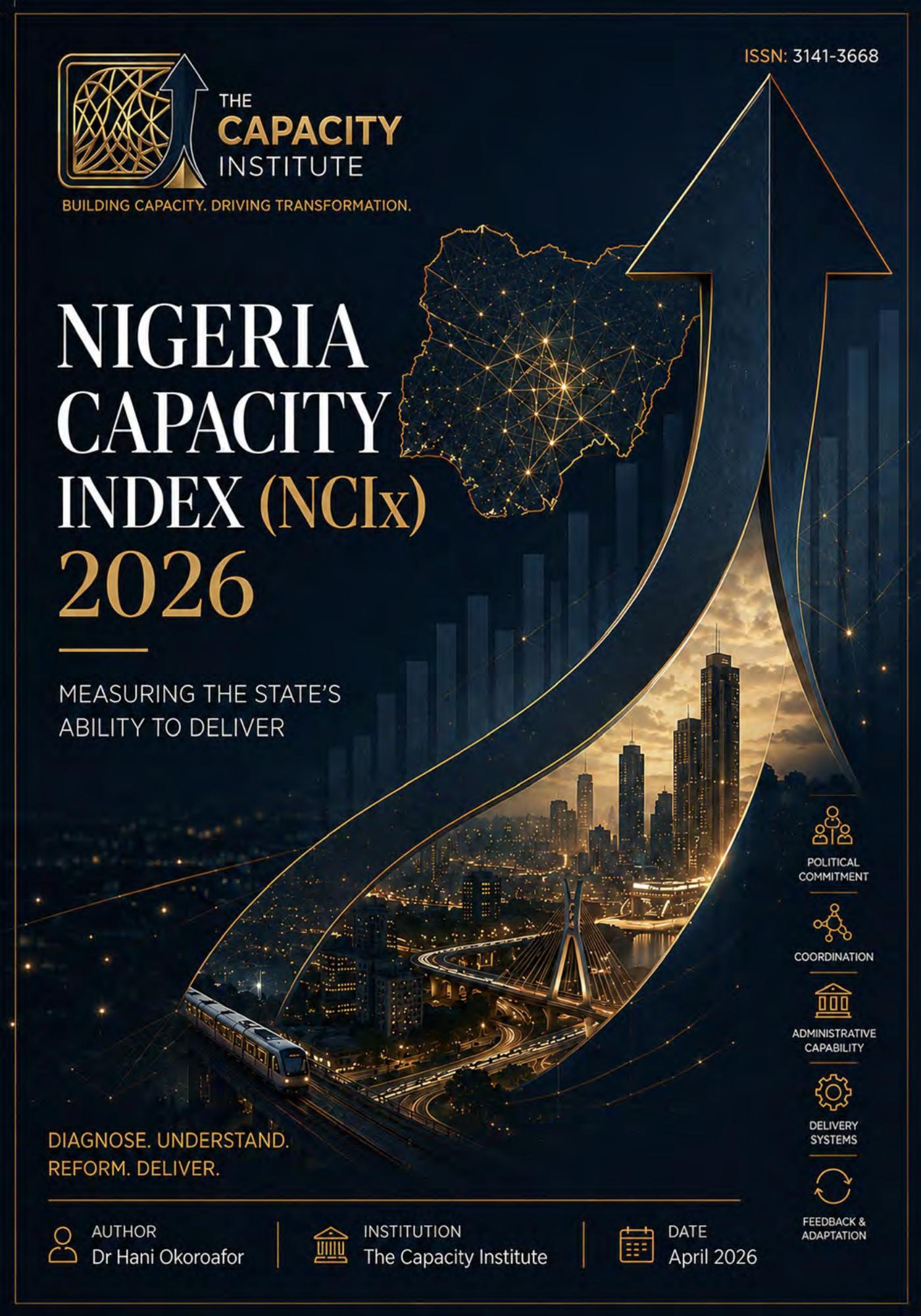
Measuring the State's Ability to Deliver
Nigeria does not lack policy.
It lacks execution.
"The central development problem is no longer knowing what to do. It is executing what is already known."
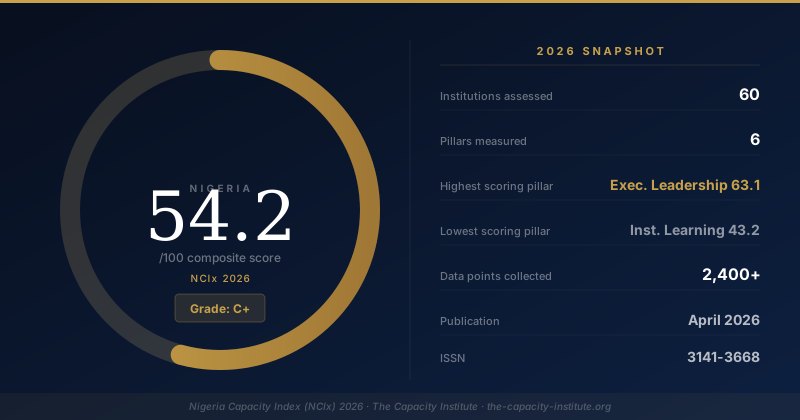
The Nigeria Capacity Index (NCIx) is an annual assessment published by The Capacity Institute. It measures the Nigerian state's ability to translate policy decisions into implemented outcomes — reliably, coherently, and at scale over time.
The NCIx is grounded in the intellectual framework of The Capacity State. It answers three critical questions: Where are we strong? Where are we weak? What should we do first?
It is not a ranking for its own sake. It is a diagnostic tool designed to translate evidence into a practical agenda for action — one that strengthens Nigeria's execution capacity and delivers real results for citizens.
"Diagnose. Understand. Reform. Deliver."
Execution Capacity is Defined As
The ability of the state to translate policy decisions into implemented outcomes reliably, coherently and at scale over time.
Three Foundational Dimensions
"Nigeria is not a collapsed system. It is a constrained one."
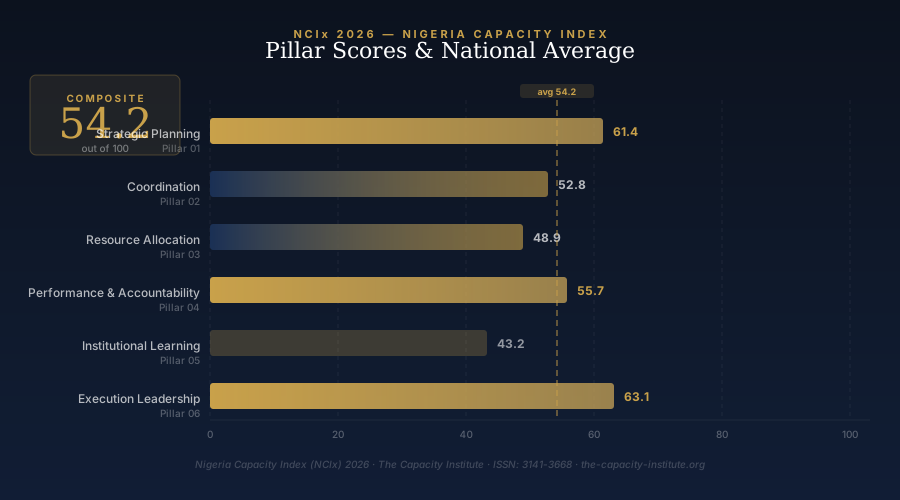
Rank 1 = highest scoring pillar. No pillar scores above 65/100. All five pillars score below 65/100.
Nigeria scores above several large economies but lags behind top performers. The difference is not in resources or talent — it is in execution.
NCIx Composite Score (0–100). Source: NCIx 2026, The Capacity Institute.
The gap between Nigeria's performance and peer medians reflects systemic execution constraints, not resource scarcity alone.
Source: NCIx 2026, The Capacity Institute. Table 1 — Execution-Relevant Indicators (Nigeria vs Benchmarks).
The NCIx translates the diagnosis into a practical agenda for action — one that strengthens Nigeria's execution capacity and delivers real results for citizens.
Focus on what matters most. Concentrate institutional energy on a small number of high-impact delivery objectives with measurable targets.
Build alignment across actors. Address the greatest constraint — fragmentation between institutions — through deliberate coordination architecture.
Simplify, standardise and enforce. Reduce bureaucratic friction and build operational discipline in delivery systems.
Learn, adapt and course-correct. Build real-time monitoring and feedback systems so institutions can detect and respond to failure early.
Sustain impact and build public trust. Better execution builds legitimacy, strengthens the social contract, and accelerates development.
"A nation rises when systems work."
NCIx 2026 · The Capacity Institute
The NCIx applies the conceptual framework developed in Hani Okoroafor's foundational work to measure and track Nigeria's execution capacity year on year. The book provides the theory. The index provides the evidence. Together, they form the diagnostic and intellectual core of The Capacity Institute.
Get the Report
NCIx 2026 · Dr Hani Okoroafor · The Capacity Institute · Lagos · April 2026
Okoroafor, H. (2026). Nigeria Capacity Index (NCIx) 2026: Measuring the State's Ability to Deliver. Lagos: The Capacity Institute. ISSN: 3141-3668.